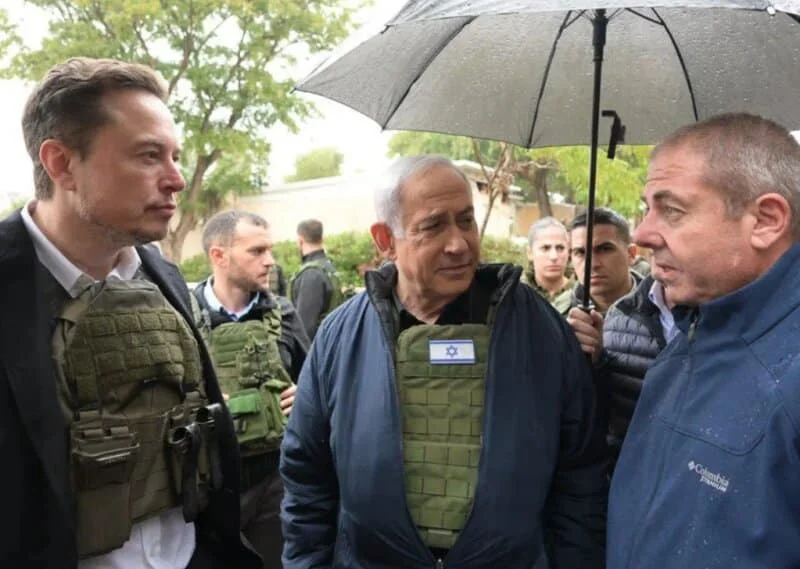
Elon Musk visited Israel to address outrage over his endorsement of an antisemitic post on his social media platform, X. He visited a kibbutz destroyed by Hamas. Israeli Prime Minister Benjamin Netanyahu took him to KfarAzza. Abigail Edan, a four-year-old American citizen who Hamas kidnapped, lived on the kibbutz.
Musk concurred with Netanyahu in a real-time internet chat that Israel needs to eliminate Hamas. “Those who are intent on murder must be neutralized. Then the propaganda must stop,” Musk said. “They’re just training people to be murderers.”
He also said that Gaza should be “prosperous.”
“I believe the future will be good if all that takes place,” he said. “I would love to help.”
Musk also met with Isaac Herzog, the president of Israel, behind closed doors.
An account of the meeting from the president’s office said that Herzog asked Musk to do something about antisemitism online.
It was said that Herzog told Musk, “Unfortunately, we are inundated with antisemitism, which is hatred of Jews.” “I believe we need to work together to stop this because the websites you run are unfortunately full of anti-Semitic and racist hate speech.”
Musk met with families of hostages
The president’s office had earlier said that family members of the Hamas prisoners had attended a meeting to talk about the suffering and uncertainty that the captives continue to endure. One of the family members, Rachel Goldberg, showed Musk the footage of her son Hersh Goldberg-Polin’s arm being blown off during the October 7 assault and expressed both concern and emotion.
“I think he was shocked that this happened while someone was at a music festival,” Goldberg stated. “What he had seen had shaken him even though he seemed very kind.”
Musk received a dog tag stating, “Our hearts are hostage in Gaza,” from the father of one of the hostages, Omer Shem-Tov, according to an early morning post on X by Herzog’s office. Musk wore the tag around his neck, as shown in the accompanying video. “I will wear it every day until your loved ones are released,” he posted on X.
According to the press office of the Israeli government, Musk was made aware of the events while he was at the demolished kibbutz by Israeli officials.
The press office stated that Musk learned about the family history of four-year-old Abigail Edan, whose parents were assassinated and who was abducted to Gaza by Hamas before being set free yesterday when he and the prime minister visited the Edan family home.
More than a week has passed since the billionaire accepted the assertion that Jewish communities incite “hatred against White people.” This is the reason for his journey to Israel. The White House chastised him and many advertisers to leave X, the platform that used to be Twitter.
Someone on X earlier this month said that Jewish groups were “pushing the exact kind of dialectical hatred against whites that they say they want people to stop using against them.” The post also talked about “hordes of minorities” coming to Western countries, which is a common antisemitic theory.
“You have said the actual truth,” Musk said in response.
Online hate groups have spread the antisemitic conspiracy theory that Jews want to bring undocumented minorities into Western countries to break up the White majority there.
In other posts at the time, Musk said that he didn’t think hatred of White people goes “to all Jewish communities.”
The Anti-Defamation League (ADL), an international organization that fights antisemitism, “unfairly attacks the majority of the West, even though the majority of the West supports the Jewish people and Israel,” he stated clearly. This is because their beliefs say they can’t criticize the minority groups that are their biggest threat.
Hate crimes against Muslims and Jews increased in the United States at the same time as the remarks. Politicians and human rights organizations swiftly denounced the remarks.
Since then, Musk has denied being racist. Last week, he wrote on X that any claims that he is antisemitic “couldn’t be further from the truth.”
Advertisers fleeing
Musk has faced criticism for the prevalence of antisemitic discourse on his platform, X. Major brands like Disney, IBM, Fox Sports, and the European Commission have halted ad spending.
Organizations such as the Center for Countering Digital Hate and the Anti-Defamation League (ADL) have attacked the organization for saying it observed a rise in hate speech on X in the last year.
The company has also faced claims from progressive media watchdog Media Matters, which highlighted antisemitic and pro-Nazi content on X. Musk has either criticized or denied these claims.
X has now sued Media Matters, saying that the group lied about how likely ads would appear next to extremist content on the site. It has also asked the companies that show its ads to help protect “freedom of speech.”
Musk’s trip to Israel happens when the fight with Hamas stops. In exchange for the release of 117 Palestinian prisoners, Hamas freed 58 hostages in the first three days of a truce. The hostages were mostly women and children. Hamas has said it wants to extend the ceasefire.
Herzog told CNN’s Wolf Blitzer on Sunday that it was both sad and happy to see freed hostages reunited with their families.
She said to Blitzer, “It makes us happy, but of course, that happiness comes with a lot of sadness because at least 200 hostages are still being held out there.”
Herzog said the ceasefire could be extended because it was initially agreed that there would be an extra day of peace for every ten hostages freed. However, he said it was up to Hamas to free more hostages.