Oman’s Sultan Qaboos died at 79 on Friday

Get an AI-generated summary of this article.

AI-generated article summary

Sultan Qaboos bin Said, one of the Middle East’s longest-serving rulers who upheld Oman’s neutrality in regional struggles, died on Friday at 79. The state media reported his cousin Haitham bin Tariq al-Said was called his successor.
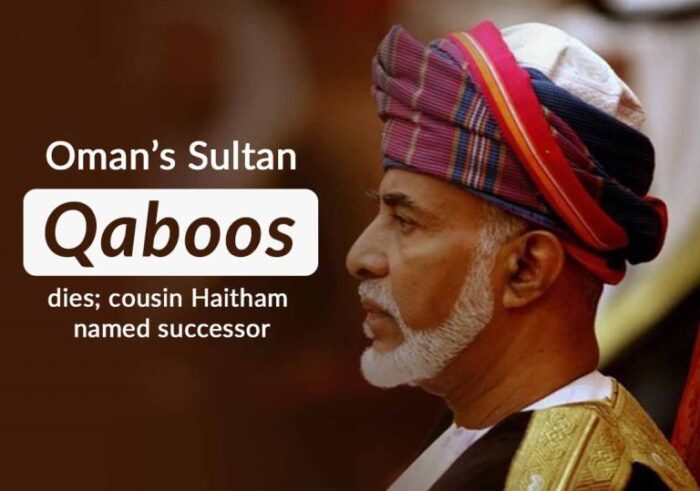
New Sultan for Oman

Following his death, the state declared three days of official mourning with flags to be flown at half-mast for 40 days for the Western-supported Qaboos, who led the country since taking over in a bloodless coup in 1970 with the aid of former colonial power Britain.

National television of Oman broadcasted images of the funeral procession driving down a road lined with palm trees. The casket, covered in the Omani flag, was then taken to Sultan Qaboos Grand Mosque in the capital, Muscat, where prayers were being performed.

State news agency ONA didn’t announce a cause of death, but Sultan had been unwell for years and stayed a week in Belgium for treatment last month.

Qaboos hadn’t publicly declared his successor, as he had no children. According to a 1996 statute, the rest of the ruling family must choose a successor within three days of the throne becoming vacant.
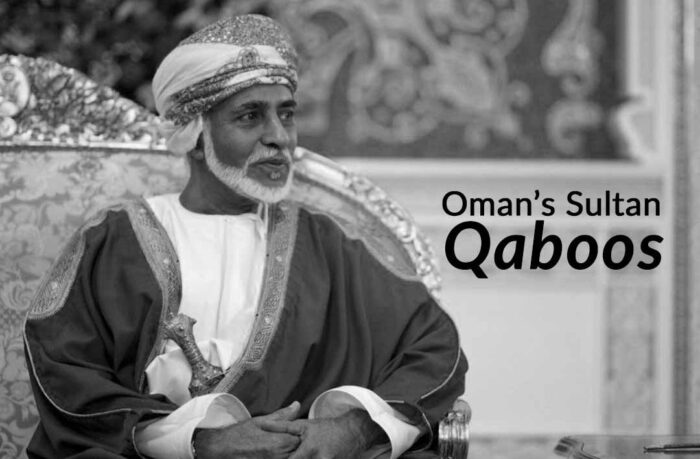
Haitham bin Tariq’s nomination as the new Sultan

Haitham bin Tariq was named on Saturday after the country’s high military council called on the ruling members’ council to convene and elect a successor.

Before being selected as a successor, Bin Tariq had served as minister of national heritage and culture and was appointed by Qaboos in 2013 as chairperson of the main committee responsible for Oman’s development.

The Middle East is now eyeing the new Omani Sultan, who is taking power at a time when domestic challenges loom large, from high unemployment rates in the indebted oil territory to strained state finances and escalated tension between Iran, the U.S., and its ally Saudi Arabia.

A smooth succession of a new Omani Sultan was expected, Kristian Coates Ulrichsen of Baker Institute told Reuters.

“Analysts are discussing whether any of Oman’s neighbouring countries might try to pressure the new sultan as he settles into power – just as the Saudis and Emiratis did with Emir Tamim in the weeks and months after he expected power in Qatar in 2013.”

Diplomats’ response

Condolences began pouring in for the white-bearded Qaboos. George W. Bush, the former U.S. President, said in a statement that the Sultan had been a stable factor in the Middle East. Dubai ruler Sheikh Mohammed bin Rashid al-Maktoum tweeted him as the Sultan of honour, wisdom, and affection.

Located on the southeastern coast of the Arabian Peninsula, Oman has long been to the Middle East what impartial Switzerland is to global diplomacy, balancing ties with two vast neighbours locked in a regional tussle, Iran to the north and Saudi Arabia to the west.

The Sultanate of Oman maintained friendly relations with Tehran and Washington and mediated U.S.-Iran talks in 2013. Two years later, these talks led to the international nuclear pact, which the Trump administration quit in 2018.

Muscat, the capital of Oman, didn’t favour the Gulf dispute that saw Riyadh and its allies impose a boycott on Qatar in mid-2017. Also, it did not establish an alliance with a Saudi-led military coalition that occurred in Yemen against the Iran-aligned Houthi movement.

The diplomatic centrality of Oman remains an attribute of Sultan Qaboos’ personality, said Simon Henderson, director of the Bernstein Program on Gulf and Energy Policy at the Washington Institute.

Final words from experts

“With Sultan Qaboos gone, it is now hard to realise how Oman can involve itself in the Iran, Yemen, and Qatar issue until a new leader has settled himself – which means for the foreseeable future.”

About Writer

Nathan Enzo
Nathan Enzo
A professional writer since 2014 with a Bachelor of Arts in Journalism and Mass Communication, Nathan Enzo ran the creative writing department for the major News Channels until 2018. He then worked as a Senior content writer with LiveNewsof.com, including national newspapers, magazines, and online work. He specializes in media studies and social communications.

More News

Trump Criticizes Pope Leo Over Iran Peace Appeal

US President Donald Trump has sparked fresh controversy after publicly criticizing Pope Leo following the pontiff’s appeal for peace amid the ongoing Iran conflict. The clash highlights growing tension between political leadership in Washington and the Vatican’s moral stance on war and global diplomacy. The dispute began after Pope Leo made a strong statement urging world leaders to avoid further escalation and prioritize peace. Without directly naming Trump, the pope warned against using power or religion to justify war. His remarks were widely interpreted as criticism of US policy. Trump responded on social media, calling the pope weak on crime and...

Why Trump Is Blockading a Strait Iran Is Already Blocking

After peace talks in Islamabad collapsed, President Trump announced the US Navy would “immediately” begin blockading the Strait of Hormuz. There is one obvious question: why would the US blockade a waterway it has been demanding Iran reopen? The Strait Is Not Fully Closed Iran has not technically sealed the Strait completely. It has been allowing some vessels through in exchange for tolls of up to $2 million per ship. Crucially, Iran has kept its own oil flowing throughout the war, exporting an average of 1.85 million barrels per day through March, slightly above pre-war levels, according to data firm Kpler. The...

Islamabad Talks | US and Iran Fail to Reach a Deal After 21 Hours

The most significant US-Iran diplomatic meeting since the 1979 Islamic Revolution ended without a deal on Sunday. After 21 hours of face-to-face talks in Islamabad. Both sides left the table blaming each other. The ceasefire that expires April 22 now hangs by a thread. What Happened in the Room The talks were the first direct US-Iranian engagement since the 2015 top-level engagement. Vice President JD Vance led the American delegation alongside Steve Witkoff and Jared Kushner. Iran was represented by Parliament Speaker Mohammad Bagher Ghalibaf and Foreign Minister Abbas Araghchi. Al Jazeera's correspondent in Islamabad described the outcome as “neither a breakthrough...

US Iran Talks Could Reshape Middle East Power Balance

A Rare Diplomatic Moment Between US and Iran The United States and Iran have entered a critical phase of diplomacy as both countries begin direct negotiations in Islamabad, Pakistan. These US Iran talks come after weeks of rising tensions that brought both nations close to conflict. While a temporary ceasefire is currently in place, the situation remains fragile. This meeting is significant because it represents one of the few direct engagements between Washington and Tehran in recent history. For decades, relations between the US and Iran have been shaped by mistrust and political conflict. The decision to begin talks shows that...

Five points to know about Iran US Talks in Islamabad

Pakistan is hosting one of the most consequential diplomatic meetings in decades. The United States and Iran are holding their highest level talks in years in Islamabad, in a Pakistan brokered bid to turn a fragile two week ceasefire into a lasting end to a war that has roiled global energy markets. The War That Made These Talks Necessary On February 28, the US and Israel launched deadly coordinated strikes that killed Supreme Leader Ali Khamenei and struck Iran's military and nuclear infrastructure. More than 3,000 people were killed in Iran in five weeks, according to Iranian media and...

Latest Articles