
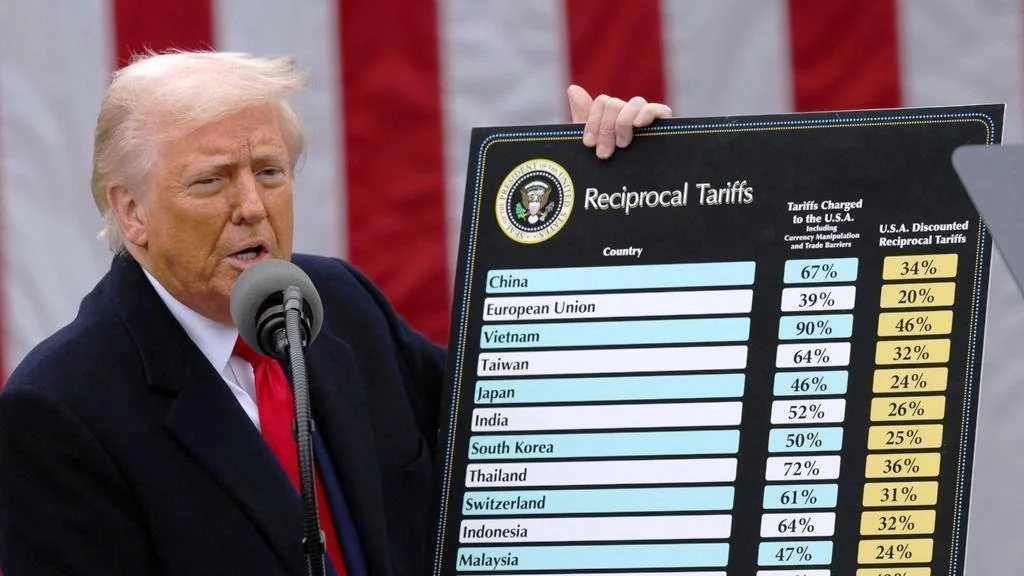
Introducing the new tariffs is causing tremendous fear in the car industry because influential experts say there will be heavy adverse effects. “Such a move could paralyze the entire sector as car manufacturers would have to deal with skyrocketing losses and fall in profit,” Da n Roeska, the analyst at Bernstein, warned his investors. The sentiment was echoed across Wall Street, with TD Cowen’s Itay Michaeli calling it “nearly the worst possible outcome” and Barclays’ Dan Levy noting, “There are no clear winners here – just companies that might suffer less than others.”
While President Trump acknowledges that the measures may initially cause “some pain,” he maintains that they will ultimately create American jobs and generate over $100 billion in annual revenue. However, automakers’ hopes for vehicle exemptions meeting USMCA trade terms have been denied. Some relief might still come for specific auto parts as final rules are crafted, but analysts expect auto stocks to remain turbulent.
As the tariff effects ripple through the market, investors face key questions: Which companies are most vulnerable? What vehicles will see the most significant price jumps? And how deep will the earnings damage go? The answers will become more apparent as the industry adapts to this new reality in the coming months.
U.S.-built does not mean U.S.-made
The auto industry is bracing for the ripple effects of new tariffs, but here’s the reality: there’s no such thing as an utterly American-made vehicle. Even cars assembled in the U.S. rely on a complex global web of parts suppliers spanning dozens of countries.
“Let’s be clear—the idea of a U.S.-made car using only U.S. parts is pure fiction,” Wedbush analyst Dan Ives warned investors. “Building that kind of supply chain would take years if possible.”
Take Ford’s F-150 pickup, often touted as an American icon. While exclusively assembled in U.S. plants, its roughly 2,700 major components (not counting smaller pieces) originate from at least 24 different countries, according to engineering firm Caresoft. This global interdependence means tariffs could create unintended consequences across the auto ecosystem.
The Trump administration’s tariff plan does include some potential relief valves. Parts compliant with the USMCA trade deal will initially avoid tariffs, though Commerce Department officials are still developing systems to tax non-U.S. content eventually. The White House also suggests automakers may get credit for using American components when calculating their tariff burdens.
As the policy takes shape, automakers face a daunting challenge: navigating a protectionist trade landscape while managing supply chains built for global efficiency. The coming months will test whether “America First” production is an achievable goal or an economic fantasy.
Automakers Facing the Biggest Tariff Headwinds
The new tariffs will hit some automakers harder than others, with import-dependent brands bracing for the heaviest blows. According to S&P Global Mobility, Volvo, Mazda, Volkswagen, and Hyundai Motor Group (including Genesis and Kia) are particularly vulnerable – at least 60% of their U.S. sales last year came from imported vehicles.
While Detroit’s Big Three and Japanese rivals Toyota and Honda dominate U.S. production – accounting for 67% of domestic light-vehicle output in 2024 – they’re not immune. Bernstein’s analysis reveals a startling fact: 57% of components in “American-made” vehicles are imported. This supply chain reality means even Ford, the nation’s top automaker, faces significant exposure.
General Motors is currently recognized as the domestic manufacturer that is the most at risk. More than 80% of its revenue comes from North America; nonetheless, almost half of the cars produced are imported. In comparison, less than 40% of the domestic manufacturing parts are sourced from the United States. Bernstein proceeds to say that the results might be catastrophic, for example:
– 79% less operating profits (EBIT)
– 81% downward in earnings per share
– $4.1 billion lower in free cash flow
Ford is expected to experience a slightly more favorable downfall, with a 16.5% decline in EBIT and a 23% reduction in EPS, whereas Stellantis is showing its comparative power by being less dependent on the U.S. market and having 56% local parts content.
The EV sector presents a stark contrast. Tesla, Rivian, and Lucid enjoy natural protection – all U.S.-sold vehicles undergo final domestic assembly. “Tesla is the clear structural winner here,” notes Bernstein’s Roeska. “They’re localized, gaining market share, and insulated from trade risk. For everyone else, this means margin compression and earnings pressure.”
As the tariff dominoes fall, the industry faces a painful reckoning with its globalized supply chains – and investors should prepare for turbulent quarters ahead.
The U.S. auto market saw an unexpected surge.
During the first quarter, there was a strong swell in the demand for consumer goods by the auto dealers, as expected. Many people have been trying to make purchases before the new rates on goods were implemented to get the best prices out of the products.
S&P Global Mobility, on the other hand, has issued an alert stating that these same tariffs will pose a dual threat to both import costs and the domestic production market, hence the ripple effect. As a result, customers will likely pay higher prices for all kinds of merchandise in the coming days. Industry forecasts now suggest annual light-vehicle sales could drop to 14.5 million and 15 million under prolonged tariffs, down from last year’s 16 million vehicles sold.
The pain of the new increased prices is the hardest for those who watch every dollar and cent of their expenses. According to analysts, vehicles of the most basic level, which have been produced with quite a small profit, will either significantly go up in price or completely go off the market. Indeed, these low-priced vehicles, usually China-made ones, are the most affected.
General Motors alone imported over 400,000 budget-friendly Buick and Chevrolet crossovers from South Korea last year, while popular models like the Toyota RAV4, Honda CR-V, Ford Maverick, and Chevrolet Equinox – all imported from Canada and Mexico – now face new tariff pressures.
Bank of America estimates the average new vehicle price, currently around $48,000, could jump by as much as $10,000 if automakers entirely pass tariff costs to consumers.
Automakers remain tight-lipped about their pricing strategies, leaving buyers in limbo. Hyundai Motor North America CEO Randy Parker’s recent comments capture the industry’s cautious stance: “We continue to evaluate all scenarios…if you’re interested in buying a car, right now is a great time because, as of today, we haven’t raised prices.” This uncertainty has created a unique window for car shoppers, though how long it remains open depends on how quickly manufacturers adjust to the new trade landscape.