
Ukrainian city to relocate schools to metro stations

How Kharkiv protects its children?
Kharkiv is trying to maintain some normalcy amid the war. Some people have returned to the city, and some shops are open. But the danger is always there. The city’s schools are too risky to use and could be hit by a random strike at any time.
So, the city has built new schools on the subway and in old tunnels. They are safer and quieter. They have colourful walls, toys, and banners that say “Indestructible Kharkiv”.
Elmira is a five-year-old girl who lives in Kharkiv, a city in northern Ukraine that is under constant threat of Russian airstrikes. She attends school in a metro station, where she feels safe from the noise of the bombs. She loves her country’s nature and wonders why Russia wants to destroy it.
Her father is a soldier on the front lines, and she hasn’t seen him since she fled to Poland with her mother for a year. On the days she doesn’t go to the metro school, she studies from home with tablets and software. She likes to sing the national anthem and play with her friends.
Kharkiv’s metro schools work
The metro schools in Kharkiv are a safer option for about 2,200 children who live in a war-torn city. They were established in September 2022, following the parents’ request. The schools are located in five different metro stations and have 19 classrooms. However, they cannot accommodate all the children in the city, so they have to take turns in grades 1-11.
The metro schools also face challenges such as limited space, resources, power outages, and security threats.
But they also offer a sense of stability and hope. They allow the children to continue their education and development and protect them from bombs and sirens.
“The kids are probably getting used to it by now,” Elmira’s teacher OlenaRudakova said. “They get used to it somehow.”
The deadly threat of Russian missiles on Ukrainian cities
Kharkiv, a city near the Russian border, is under constant attack from Moscow. The mayor, IhorTerekhov, told CNN that an S-300 missile could hit the city in less than a minute.
“There is no time for an air raid alert,” he said.
The city has many emergency shelters, but they are not enough to protect the civilians from the Russian strikes. Terekhov said that Russia targets not only the energy infrastructure but also the residential areas to terrorize the people.
“There are many casualties,” he said.
Elmira’s old school was one of the buildings Russia shelled in the first months of the war. Luckily, no one was hurt, as the families hid in the basement.
But many others were not so fortunate.
Since Russia invaded Ukraine in February 2022, more than 10,000 civilians, including over 560 children, have been killed, according to the UN. More than 18,500 people have been injured. The actual numbers could be much higher, as it is hard to verify the deaths in the conflict zones.
The Ukrainian city has created new schools in the subway and old tunnels for children’s safety and education. They are more secure and quiet than the regular schools, which are too risky to use.
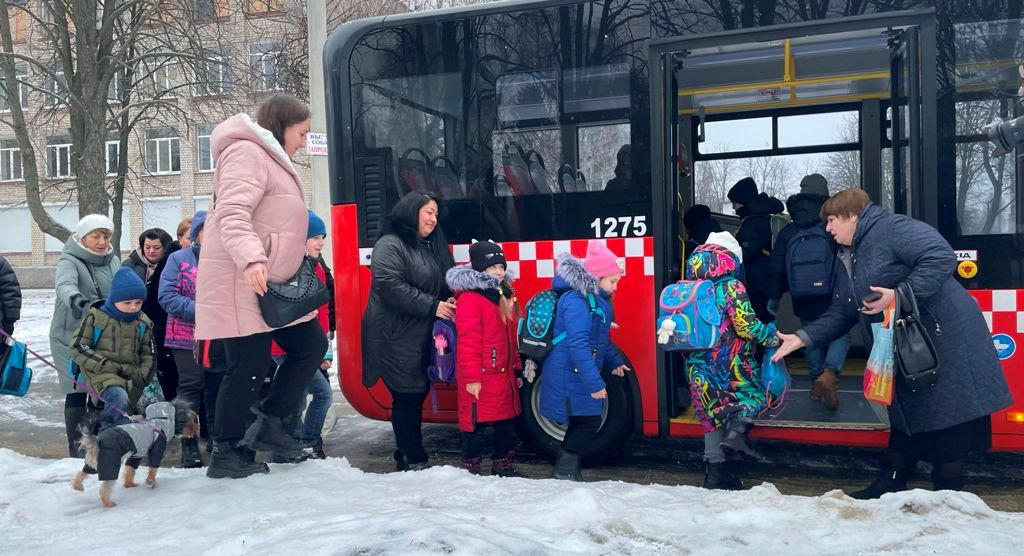
Elmira attends a metro school in Kharkiv, a city under war. She travels by bus from her old school to the station, where her classroom has windows that mute the outside noise. “We don’t hear the bangs here,” Elmira told CNN. She loves her country and its nature, which she believes provoked Russia’s attack. She longs for her father, who is on the front lines.
Elmira recalls fleeing to Poland with her mom for a year. She also likes studying and having fun with her friends. She sings the anthem every morning and uses tablets and software to learn from home on alternate days.
The challenges and hopes of Kharkiv’s metro schools
The city is also building a new underground school that will look like a bunker. It will span about a football field and house 450 students. It will have lighting, noise insulation, and ventilation and open in March.
“The lungs must breathe as they do in the fresh air; it’s essential,” Terekhov said of the school’s future students.
The resilience and growth of Kharkiv’s children
A psychologist is now part of the staff at the metro station, an essential pillar of wartime teaching.
“Children have survived explosions, experienced difficult moments, and the death of relatives; it is tough for them,” Elmira’s teacher Rudakova told CNN between classes.
She noticed a big change in her students when they returned to classes last September.
“They looked like grown-ups who had endured hardships,” she said.
Rudakova said play is central to the syllabus, as they try to make learning enjoyable.
Rudakova told CNN that teachers are careful about topics that could upset their students. They avoid mentioning dads in classes where children have lost their fathers.