
Trump Signals Tougher Russia Sanctions After Zelenskyy Meeting

Get an AI-generated summary of this article.

AI-generated article summary

On Saturday, April 26, 2025, US President Donald Trump suggested imposing stricter sanctions on Russia, expressing skepticism about Russian President Vladimir Putin’s desire to end the war with Ukraine.

In a Truth Social post, Trump condemned Putin’s recent missile strikes on Ukrainian civilian areas, stating, “There was no reason for Putin to be shooting missiles into civilian areas, cities, and towns over the last few days.”

He questioned Putin’s commitment to peace, adding, “It makes me think that maybe he doesn’t want to stop the war; he’s just stringing me along, and we need to handle this differently, perhaps through banking or secondary sanctions. Too many people are dying!!!” Vice President JD Vance amplified the message by sharing Trump’s post on X.

As clarified through research, secondary sanctions target foreign entities doing business with sanctioned parties, such as Russian banks or companies, even if those transactions do not involve the US. These measures extend US economic pressure globally by discouraging third-party dealings with Russia (Sanctions Explained).
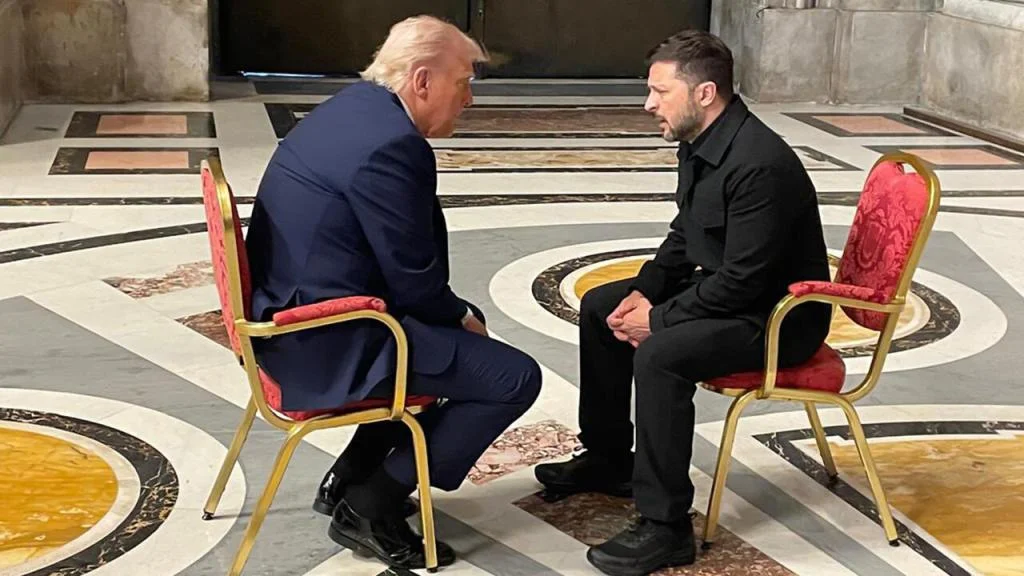
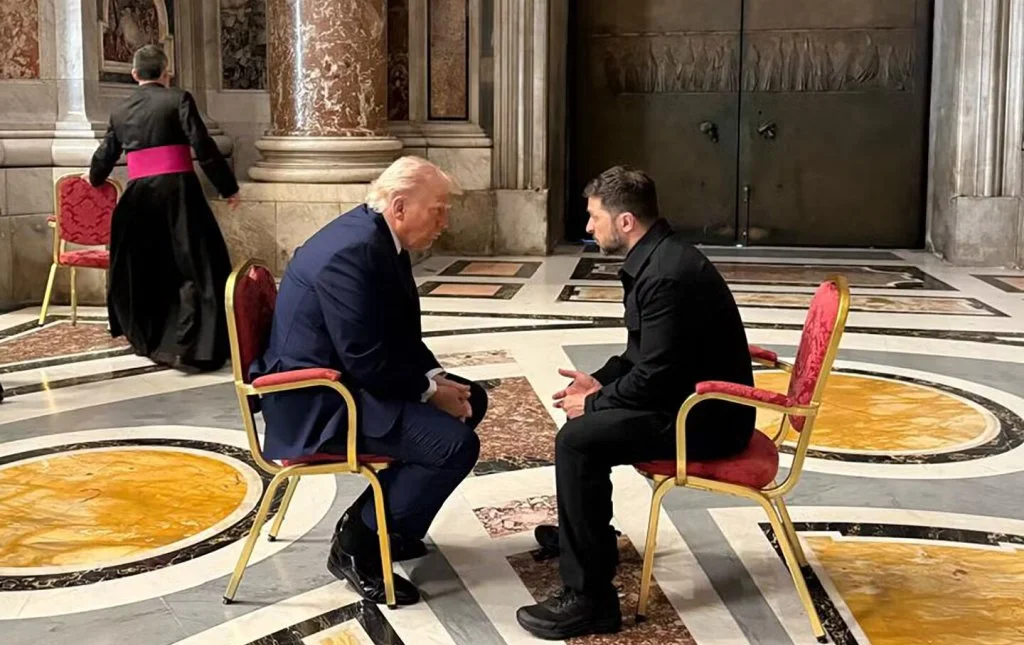
Trump and Zelensky meet up at Pope Francis's funeral.
In this photo from the Ukrainian Presidential Press Office, Ukraine’s President Volodymyr Zelenskyy and President Donald Trump talk at Pope Francis’ funeral in the Vatican on April 26, 2025.

Trump’s comments followed a meeting with Ukrainian President Volodymyr Zelenskyy in Rome, their first in-person encounter since a heated Oval Office discussion on February 28, 2025, which had escalated into a shouting match over US support and peace efforts. The Rome meeting held just before Pope Francis’s funeral was described by the White House as “very productive,” though no specific details were shared. Zelenskyy called it a “good” and “very symbolic” meeting, noting, “It has the potential to become historic if we achieve joint results.”

Push for a Peace Deal

Trump’s remarks are part of his ongoing effort to reach a peace agreement between Russia and Ukraine. Earlier that week, he proposed a deal recognizing Crimea as Russian territory, a condition Zelenskyy has firmly rejected as a non-negotiable “red line.” On Friday, April 25, 2025, Trump claimed on Truth Social that Russia and Ukraine are “very close to a deal” and urged high-level talks to “finish it off,” asserting, “Most of the major points are agreed to.” However, the Crimea issue remains a significant obstacle.

In an unexpected move, Trump recognized in his post on Saturday that Russia “took” Crimea from Ukraine, which is the illegal annexation of 2014.

He accused the past President of the US, Barack Obama, and stated, “He made it possible for Russia to steal Crimea from Ukraine without even a shot being fired.”

However, in early April 2025, Trump’s comments to TIME magazine suggested that “Crimea will stay with Russia,” adding, “Zelenskyy understands that, and everybody understands that it’s been with them for a long time. It’s been with them long before Trump came along.” Zelensky swiftly countered, reiterating that Crimea belongs to Ukraine.

The Rome meeting followed a strained Oval Office encounter where Trump and Vice President JD Vance criticized Zelenskyy for not showing enough gratitude for US aid and for resisting peace talks with Russia. The February 2025 meeting, meant to discuss a U.S.-Ukraine minerals deal, highlighted ongoing tensions in U.S.-Ukraine relations, making the Rome discussion a critical moment for diplomacy.

About Writer

More News

Trump Criticizes Pope Leo Over Iran Peace Appeal

US President Donald Trump has sparked fresh controversy after publicly criticizing Pope Leo following the pontiff’s appeal for peace amid the ongoing Iran conflict. The clash highlights growing tension between political leadership in Washington and the Vatican’s moral stance on war and global diplomacy. The dispute began after Pope Leo made a strong statement urging world leaders to avoid further escalation and prioritize peace. Without directly naming Trump, the pope warned against using power or religion to justify war. His remarks were widely interpreted as criticism of US policy. Trump responded on social media, calling the pope weak on crime and...

Why Trump Is Blockading a Strait Iran Is Already Blocking

After peace talks in Islamabad collapsed, President Trump announced the US Navy would “immediately” begin blockading the Strait of Hormuz. There is one obvious question: why would the US blockade a waterway it has been demanding Iran reopen? The Strait Is Not Fully Closed Iran has not technically sealed the Strait completely. It has been allowing some vessels through in exchange for tolls of up to $2 million per ship. Crucially, Iran has kept its own oil flowing throughout the war, exporting an average of 1.85 million barrels per day through March, slightly above pre-war levels, according to data firm Kpler. The...

Islamabad Talks | US and Iran Fail to Reach a Deal After 21 Hours

The most significant US-Iran diplomatic meeting since the 1979 Islamic Revolution ended without a deal on Sunday. After 21 hours of face-to-face talks in Islamabad. Both sides left the table blaming each other. The ceasefire that expires April 22 now hangs by a thread. What Happened in the Room The talks were the first direct US-Iranian engagement since the 2015 top-level engagement. Vice President JD Vance led the American delegation alongside Steve Witkoff and Jared Kushner. Iran was represented by Parliament Speaker Mohammad Bagher Ghalibaf and Foreign Minister Abbas Araghchi. Al Jazeera's correspondent in Islamabad described the outcome as “neither a breakthrough...

US Iran Talks Could Reshape Middle East Power Balance

A Rare Diplomatic Moment Between US and Iran The United States and Iran have entered a critical phase of diplomacy as both countries begin direct negotiations in Islamabad, Pakistan. These US Iran talks come after weeks of rising tensions that brought both nations close to conflict. While a temporary ceasefire is currently in place, the situation remains fragile. This meeting is significant because it represents one of the few direct engagements between Washington and Tehran in recent history. For decades, relations between the US and Iran have been shaped by mistrust and political conflict. The decision to begin talks shows that...

Five points to know about Iran US Talks in Islamabad

Pakistan is hosting one of the most consequential diplomatic meetings in decades. The United States and Iran are holding their highest level talks in years in Islamabad, in a Pakistan brokered bid to turn a fragile two week ceasefire into a lasting end to a war that has roiled global energy markets. The War That Made These Talks Necessary On February 28, the US and Israel launched deadly coordinated strikes that killed Supreme Leader Ali Khamenei and struck Iran's military and nuclear infrastructure. More than 3,000 people were killed in Iran in five weeks, according to Iranian media and...

Latest Articles