
Trump’s Student Loan Collections Cut Billions from Low-Income Americans’ Income

Get an AI-generated summary of this article.

AI-generated article summary

Trump adminsitration has resumed debt collections on defaulted student loans in May.
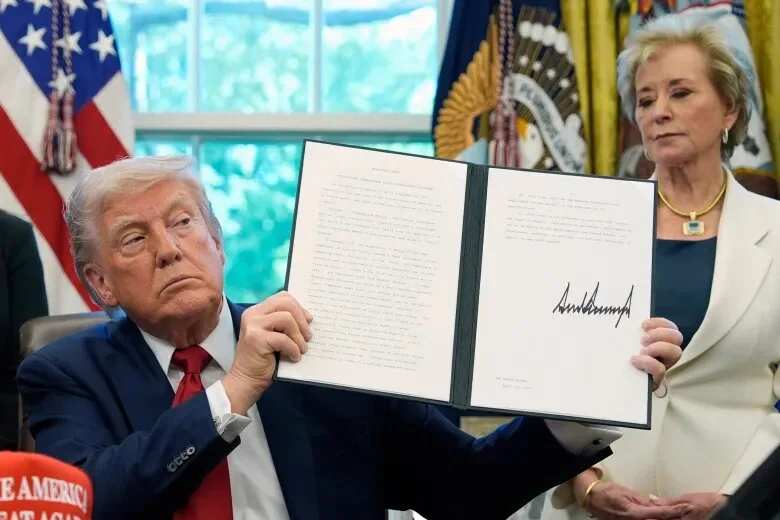
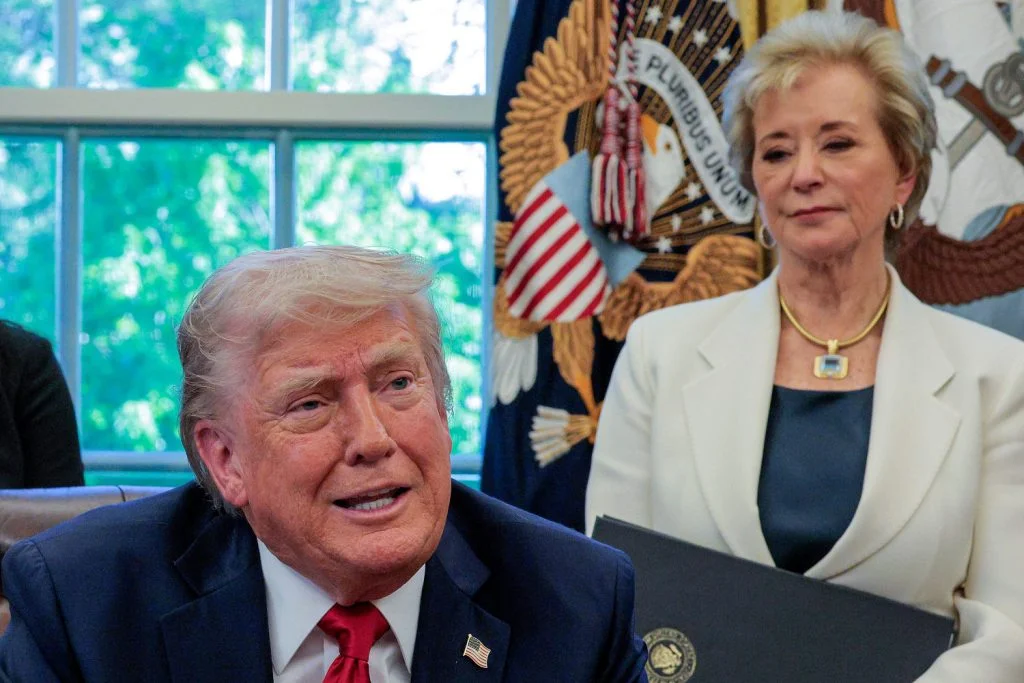
On April 23, President Trump and Education Secretary McMahon were in the Oval Office to discuss key educational initiatives.


In May 2025, the U.S. Department of Education, under President Donald Trump, restarted collections on defaulted student loans. For the first time in five years, borrowers who missed payments face wage garnishment, seized tax refunds, or Social Security cuts.

This follows a pause in March 2020 due to the COVID-19 pandemic. “Borrowers should pay back their debts,” said Education Secretary Linda McMahon on X on April 22. According to Bank of America, the move aims to recover part of the $1.6 trillion student loan debt, which grew by $500 billion in the last decade.

JPMorgan estimates collections could reduce disposable personal income by $3.1 billion to $8.5 billion monthly. This depends on interest rates and repayment plans. In a single quarter, defaulted and seriously delinquent loans could cut 0.7% to 1.8% from yearly disposable income, said Murat Tasci, a senior JPMorgan economist.

Low-income and subprime borrowers, already struggling, will face the most brutal hit. “This will knock on broader consumer finances, especially for the subprime segment,” wrote Bank of America analyst Mihir Bhatia.

The New York Fed says 25% of borrowers required to pay are behind, with 8% of loans delinquent in Q1 2025, up from 0.5% last quarter.

The policy adds pressure on consumers who are already strained by Trump’s tariffs and inflation. According to JPMorgan, tariffs, including a 10% global rate, could raise prices by 1-1.5%.

This could push disposable income growth negative in mid-2025, raising recession risks. Consumer sentiment, tracked by the University of Michigan, hit historic lows in early 2025. “You have rising pressure points,” said LPL Financial’s chief economist Jeffrey Roach. “In aggregate, it’s enough to quash spending.” Borrowers face credit score drops of up to 129 points, per VantageScore, or 171 points, per the Federal Reserve. This makes it harder to rent, buy homes, or get jobs.

Student loans are 9% of consumer debt but 30% when excluding mortgages, per Bank of America. With 5.3 million borrowers in default and 4 million in late-stage delinquency, collections could affect nearly 25% of loans if delinquencies worsen. Part of the reason people add to credit card debt is student loan payments.

“That’s the spillover effect,” said Ted Rossman of Bankrate. The New York Fed warns of risks to other debts, like credit cards, as borrowers struggle. Social media posts on X show alarm, with one user noting a 150-point credit score drop after payments spiked. Another said their payment quadrupled to $900.

Not all experts see a significant economic hit.

Roach argues that high-income earners drive most spending and will keep the economy afloat. “The student loan story is not as important as other stories,” he said. Trump’s proposed tax cuts on overtime and tips might ease some pain for low-income borrowers.

However, JPMorgan initially forecasted a 60% chance of a recession due to tariffs, though it later dropped below 50% after tariff reductions. Bank of America’s Brian Moynihan sees no recession, but Wells Fargo notes stress among lower-income consumers. The economy’s fate depends on consumer spending amid rising prices and a 4.8% unemployment peak projected for 2026.

The Trump administration’s push contrasts with Biden’s relief-focused approach. Biden’s SAVE plan, which capped payments at 5% of income, is blocked in court. Current plans can charge up to 20%, hitting 8 million borrowers hard. The Education Department is laying off staff, complicating loan management.

Borrowers can seek forbearance or income-driven plans to avoid default, but options are limited. “It’s short-term pain but brings certainty,” said economist Michael Jones. Critics, like the Community Service Society of New York, call it “brutal” amid tariff-driven price hikes and layoffs. With 42 million Americans owing student debt, the policy’s impact will shape consumer finances and economic stability.


About Writer

More News

US-UK Special Relationship Sours Over Iran War

A year ago, the United States and the United Kingdom were celebrating what both sides called an unbreakable bond. Britain signed the first trade deal with the US in May 2025. Trump made a second state visit to the UK in September. King Charles hosted him at Windsor Castle. Things looked good. Today, they look very different. The Iran war broke the spell. Trump has attacked NATO allies throughout the conflict for refusing to support military operations against Iran, and he has singled out the UK in particular. He called Starmer “no Winston Churchill,” labelled British immigration and energy policies...

Iran War: Hormuz Closes Again, Trump Says Deal Is Near

Fifty days into the US and Israel war on Iran, the situation on April 18 remains a tangle of contradictions. Trump said there are no sticking points left for a deal, while insisting the US blockade will remain until any agreement is fully complete. Meanwhile, Iran closed the Strait of Hormuz again until the US lifts the blockade of its ports hours after Trump said he was optimistic about reaching a deal with Tehran. The Strait of Hormuz Open, Closed, Open Again Iran reopened the Strait of Hormuz earlier on Saturday subject to conditions, in line with the Lebanon ceasefire and...

Trump and Xi Meeting Ends with High Stakes, Few Deals, and a Taiwan Warning

US President Donald Trump arrived in Beijing on May 13 for the most consequential American presidential visit to China in nearly a decade, touching down at Beijing Capital International Airport to a ceremony featuring an honor guard and crowds of children waving Chinese and American flags. The two day summit opened with warm words and a careful agenda, but by the time both sides released their readouts of the first day of talks, it became clear that Washington and Beijing were still telling very different stories about what had happened in the room. How the Summit Opened Trump was greeted by...

BYD and KFC Changing the Future of EV Charging

In a move that blends fast food with futuristic mobility, Chinese electric vehicle giant BYD has partnered with KFC to introduce a new concept that could redefine how people think about charging their cars. Instead of waiting at traditional charging stations, drivers in China may soon be able to recharge their vehicles while picking up a meal in just minutes. The collaboration focuses on what both companies describe as a nine-minute one-stop refueling experience. This idea is built around BYD’s advanced battery technology, which can charge a vehicle from low levels to nearly full capacity in about nine minutes. Solving One...

Two Months of Iran War | Who Is Winning, Who Is Losing, and Who Is Still Deciding?

Two Months Into the Iran War When Donald Trump launched the war on Iran on February 28, he told the world it would be quick, decisive, and worth it. Ten days in, he said the United States had already won the war “in many ways.” (function(w,q){w=w||;w.push()})(window,"_mgq"); Two months later, a definitive end to the conflict is nowhere in sight. A ceasefire is in place but fragile. Diplomacy keeps stalling. And almost every country pulled into this war willingly or not is paying a price it did not budget for. (function(v,d,o,ai){ai=d.createElement('script');ai.defer=true;ai.async=true;ai.src=v.location.protocol+o;d.head.appendChild(ai);})(window, document, '//a.vdo.ai/core/v-livenewsof/vdo.ai.js'); “There aren’t any real winners from the war, but there are some...

Latest Articles