
At the very latest, the budget for the US federal government had not been passed, resulting in a shutdown at midnight on October 1, 2025.
Due to Congress not agreeing on the budget, a political stalemate led to the first general shutdown since 2019. With both the White House and Congress under Republican control, the House voted on September 20 for a simple stopgap measure that maintained current levels with no amendments. Democrats blocked it in the Senate, demanding extensions of enhanced Affordable Care Act subsidies and funds for healthcare and border security.
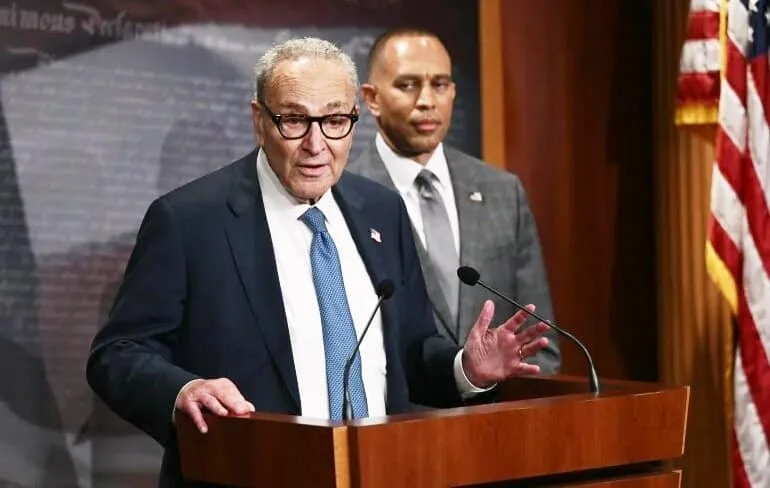
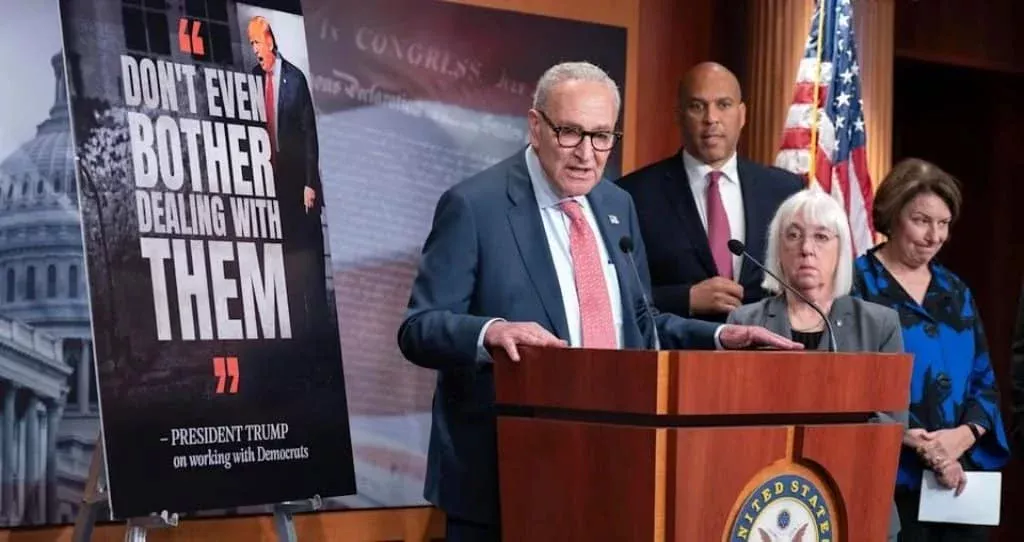
Senate Minority Leader Chuck Schumer called the House bill a “surrender to extremism,” urging GOP leaders to engage in negotiations. President Trump accused Democrats of “radical left policies” like “healthcare for illegal aliens on September 24, 2025.
It’s Not a Full but a Partial Shutdown
Unlike partial shutdowns, where some agencies are funded, this is a “full” shutdown because none of the 12 appropriations bills have been passed by either chamber, according to the Bipartisan Policy Center. Congress must fund discretionary spending annually from October 1; failure to do so halts non-essential operations. The House’s bill avoided Democratic priorities, forcing the Senate—requiring 60 votes for cloture—to act. House Speaker Mike Johnson refused to recall the House before October 1, leaving the Senate to bridge the gap. Since 1980, there have been 14 shutdowns, but this one risks being longer amid midterm tensions.
Democrats Are Responsible for the Shutdown
Listing concerns like open borders and no punishments for offenders, Trump attacked Democrats. Schumer answered that Trump would rather throw a tantrum than do his job. While Democrats point to healthcare costs and accuse the cancellation of “chickening out,” Republicans fault Democrats for blocking a “clean” extension. The GOP is employing brinkmanship to get around addressing the collapsing subsidies by 2025. T
he standoff matches the 2018–2019 era, when Trump charged Democrats with a 35-day closure. On X on September 24, 2025, SenSchumer attacked “MAGA Republicans.” Rep. Jeffries cautioned against “unnecessary pain.”
Critical functions, such as Social Security and Medicare, as well as debt payments on $37.5 trillion, will proceed, according to the Social Security Administration. The IRS can use Inflation Reduction Act funds to process returns and pay 74,300 staff. Defense, border patrol, and immigration enforcement remain funded via Trump’s “big, beautiful bill.” The VA will maintain medical care, suicide prevention, and crisis lines, per its plan. The FDA will respond to emergencies but pause inspections, per HHS. Courts will operate with judges paid, but staff dismissals are looming, according to the judiciary.
Non-Essential Services Halt
Non-essential operations will be closed, resulting in the furlough of approximately 800,000 workers. Food inspections, national parks, and IRS rebates are all halted. A 16-day shutdown resulted in a $414 million loss for the Park Service in 2013; the funds were allocated to Utah and Arizona.
The year 2023 marks the anniversary of the National Parks Conservation Association’s establishment. TSA and air traffic controllers remain on duty without pay, but past shortages have caused airport closures, according to the National Air Traffic Controllers Association. The US Travel Association warned of $1 billion weekly losses from delays and canceled trips.
Impact on Federal Employees
Rachel Snyderman from the Bipartisan Policy Center reports that 1.4 million federal employees were designated as essential in March 2025, but 900,000 workers were instructed to return home. Affected workers will undoubtedly receive the money they are due, but the payment process will still take some time. On the other hand, contractors’ income is cut off immediately.
The Congressional Budget Office notes that the 2018-2019 shutdown resulted in a $3 billion loss in GDP. One of the FAA controllers, not the one involved in the shutdown, had to borrow money from his family. While an IRS employee worries about backlogs, a VA provider worries about service interruptions. A BOP officer said, cutting activities to save, “We’re middle-class families.” NTEU posted on X on September 26, 2025, asking Congress to take action.
Economic and Political Consequences
Shutdowns can delay the release of economic data, such as the October 3 jobs report, according to the Department of Labor. The 2018-2019 crisis resulted in a $2 billion reduction in tax revenues, according to the CBO. Travel losses reach $1 billion weekly, according to the US Travel Association. Midterms add pressure, with Democrats risking blame for blocking a “clean” bill. Trump’s OMB memo signals aggressive cuts. Brookings’ Molly Reynolds noted Trump may make shutdowns “more painful” to force concessions.
No Solutions Coming Out of the Way So Far
According to Trump, he would be ready to meet the Democrats “if they get serious,” but his expectations are not clearly defined. McConnell has the potential to facilitate an agreement.
Despite the Democrats’ support for the funds allocated for the border, Republicans are strongly opposed to it. The danger of the shutdown might require a consensus; yet, the result of a stalemate could still linger for several weeks.
Jeffries didn’t like the idea of the House returning late, and he wanted it to come back by September 29. On X, Rep. Jeffries warned on September 24, 2025, that “pain” is a problem for the American people. Many families seeking employment are preparing for tough times.