

Trump Administration to Begin Russia-Ukraine Peace Talks in Saudi Arabia 

Get an AI-generated summary of this article.

AI-generated article summary

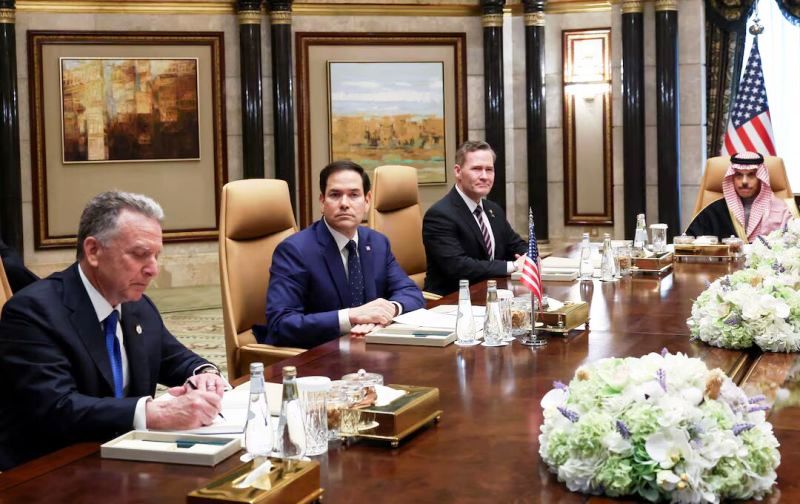
According to senior U.S. officials, President Donald Trump’s administration will likely initiate peace negotiations between Russia and Ukraine in Saudi Arabia. This has raised concerns among Ukraine and its European allies about being sidelined in the talks.

The U.S. delegation will reportedly include Secretary of State Marco Rubio, National Security Adviser Mike Waltz, and White House Middle East envoy Steve Witkoff.

U.S. Representative Michael McCaul, chairman of the House Foreign Affairs Committee, confirmed the talks during the Munich Security Conference, stating that the goal is to arrange a meeting between Trump, Ukrainian President Volodymyr Zelenskyy, and Russian President Vladimir Putin and “finally bring peace and end this conflict.”

Zelenskyy expressed skepticism about the talks. He stated that he had not received any invitations to participate and emphasized that Ukraine would never accept a peace deal negotiated without its involvement. “Maybe there is something on the table, but not on our table,” Zelenskyy told reporters. He reiterated Ukraine’s demand for Russia to withdraw from occupied territories and for Kyiv to receive NATO membership or equivalent security guarantees as part of any agreement.

Russia, which invaded Ukraine in February 2022 and currently occupies about 20% of its territory, has insisted that Ukraine cede control of disputed regions and adopt permanent neutrality as a condition for peace. Russian Foreign Minister Sergei Lavrov held a phone call with Rubio on Saturday, during which both sides agreed to maintain regular contact to prepare for a potential Trump-Putin meeting.

The Trump administration’s unilateral approach has alarmed European allies, who fear being excluded from critical negotiations. European officials have stressed that any peace deal would be unworkable without Ukraine’s direct involvement and the support of NATO members. “Any agreement would be impossible to implement unless we and the Ukrainians are included in negotiating it,” one European official said.

Trump’s Remarks

Trump wanted to comfort Ukraine by telling reporters at the White House that it would have a seat at the table throughout peace negotiations. Yet his prior gestures toward Putin, including obvious compromises on Ukraine’s core demands, have raised questions about whether the U.S. could give a treaty with Russia first consideration over Ukraine’s sovereignty and security.

During the peace discussions, negotiations over a critical minerals deal between the U.S. and Ukraine have also been underway. Zelenskyy said a draft note from Washington was short on the security measures Kyiv considers indispensable. Sources show the U.S. suggested claiming 50% of Ukraine’s vital elements, which has sparked more discussion of the area’s balance of power and resource control.

The Saudi Arabia negotiations signify a high-risk diplomatic endeavor, but their outcome is doubtful. The way to peace is full of difficulties since Ukraine is vehemently opposed to any agreement that would compromise its territorial integrity or exclude its involvement and since European partners are concerned about being ignored. The result of these negotiations, watched by the world, might remake Eastern Europe and go beyond the geopolitical scene.

About Writer

More News

US-UK Special Relationship Sours Over Iran War

A year ago, the United States and the United Kingdom were celebrating what both sides called an unbreakable bond. Britain signed the first trade deal with the US in May 2025. Trump made a second state visit to the UK in September. King Charles hosted him at Windsor Castle. Things looked good. Today, they look very different. The Iran war broke the spell. Trump has attacked NATO allies throughout the conflict for refusing to support military operations against Iran, and he has singled out the UK in particular. He called Starmer “no Winston Churchill,” labelled British immigration and energy policies...

Iran War: Hormuz Closes Again, Trump Says Deal Is Near

Fifty days into the US and Israel war on Iran, the situation on April 18 remains a tangle of contradictions. Trump said there are no sticking points left for a deal, while insisting the US blockade will remain until any agreement is fully complete. Meanwhile, Iran closed the Strait of Hormuz again until the US lifts the blockade of its ports hours after Trump said he was optimistic about reaching a deal with Tehran. The Strait of Hormuz Open, Closed, Open Again Iran reopened the Strait of Hormuz earlier on Saturday subject to conditions, in line with the Lebanon ceasefire and...

Trump and Xi Meeting Ends with High Stakes, Few Deals, and a Taiwan Warning

US President Donald Trump arrived in Beijing on May 13 for the most consequential American presidential visit to China in nearly a decade, touching down at Beijing Capital International Airport to a ceremony featuring an honor guard and crowds of children waving Chinese and American flags. The two day summit opened with warm words and a careful agenda, but by the time both sides released their readouts of the first day of talks, it became clear that Washington and Beijing were still telling very different stories about what had happened in the room. How the Summit Opened Trump was greeted by...

BYD and KFC Changing the Future of EV Charging

In a move that blends fast food with futuristic mobility, Chinese electric vehicle giant BYD has partnered with KFC to introduce a new concept that could redefine how people think about charging their cars. Instead of waiting at traditional charging stations, drivers in China may soon be able to recharge their vehicles while picking up a meal in just minutes. The collaboration focuses on what both companies describe as a nine-minute one-stop refueling experience. This idea is built around BYD’s advanced battery technology, which can charge a vehicle from low levels to nearly full capacity in about nine minutes. Solving One...

Two Months of Iran War | Who Is Winning, Who Is Losing, and Who Is Still Deciding?

Two Months Into the Iran War When Donald Trump launched the war on Iran on February 28, he told the world it would be quick, decisive, and worth it. Ten days in, he said the United States had already won the war “in many ways.” (function(w,q){w=w||;w.push()})(window,"_mgq"); Two months later, a definitive end to the conflict is nowhere in sight. A ceasefire is in place but fragile. Diplomacy keeps stalling. And almost every country pulled into this war willingly or not is paying a price it did not budget for. (function(v,d,o,ai){ai=d.createElement('script');ai.defer=true;ai.async=true;ai.src=v.location.protocol+o;d.head.appendChild(ai);})(window, document, '//a.vdo.ai/core/v-livenewsof/vdo.ai.js'); “There aren’t any real winners from the war, but there are some...

Latest Articles