
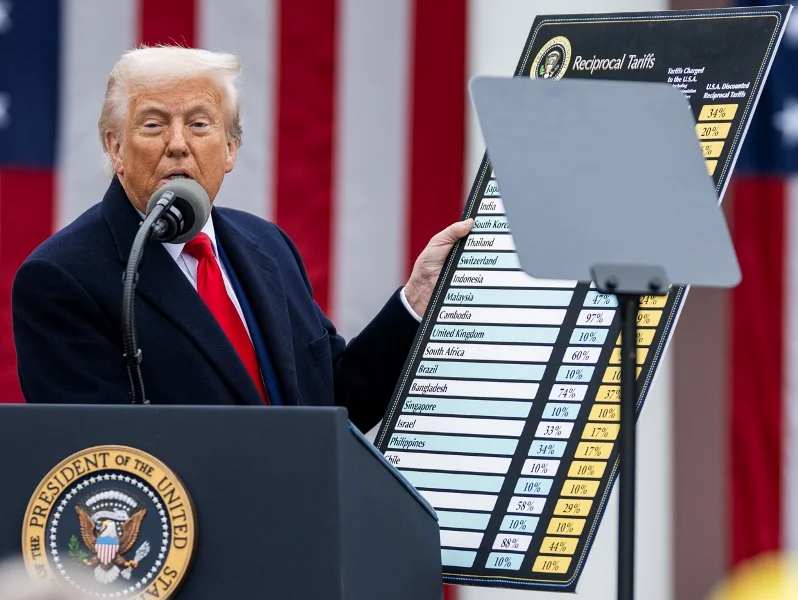
Tariffs Top Investors’ Worries, Schroders Survey Finds

Get an AI-generated summary of this article.

AI-generated article summary

Key Points:

  • Nearly two-thirds (63%) of investors view tariffs as the most considerable macroeconomic risk, according to a Schroders survey, which outpaces other concerns by over six times.
  • U.S. tariffs, including a 25% tax on Mexico and Canada and a 10% tax on China, have sparked market swings, according to Reuters.
  • Investors fear inflation and recession risks, with J.P. Morgan reducing its 2025 U.S. GDP growth forecast to 1.6%.

A Schroders survey released June 12, 2025, found that 63% of institutional investors and wealth managers view tariffs as their top macroeconomic worry.

The poll, conducted in April and May 2025, surveyed nearly 1,000 investors managing $67 trillion in assets. Tariffs outranked other risks, such as inflation or geopolitics, by over six times, according to CNBC.
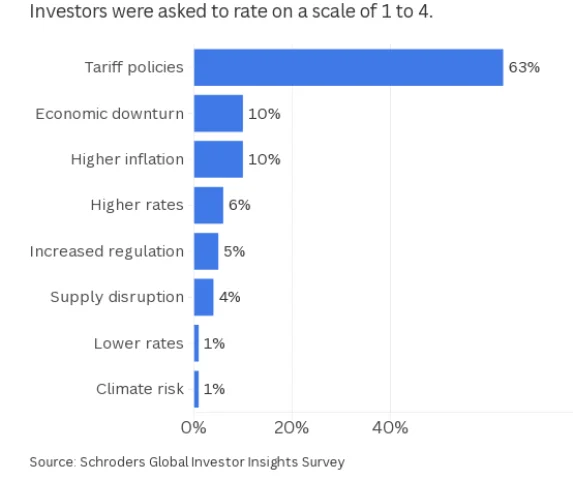
Schroders revealed that 63% of investors consider tariffs as the highest risk.

Conducted before the U.S.-China trade deal was announced on June 11, 2025, the survey reflects concerns about potential trade wars. The deal, awaiting approval from President Donald Trump and Xi Jinping, aims to lower tariffs by 55% and ease tensions, according to posts on X.

Market Volatility and Trade Deal

President Trump’s tariff policies, including a 25% tariff on Mexican and Canadian imports and a 10% tariff on Chinese goods, roiled markets. The S&P 500 declined 12% from its February 2025 peak, according to Reuters.

A 90-day tariff pause on Mexico and Canada spurred a 9.5% rebound in the S&P 500 on April 9, 2025, but volatility persists, with the VIX index at its 2023 highs.

The U.S.-China deal, which reduces tariffs and secures rare earth supplies, has calmed some fears, according to a post by @dailyupdates04. However, J.P. Morgan warns tariffs still pose inflationary risks, cutting 2025 U.S. GDP growth to 1.6%.

The survey shows that 80% of investors plan to increase actively managed investments to navigate volatility.

“Resilience now tops the investment agenda,” said Johanna Kyrklund, Schroders’ chief investment officer. “Markets are adjusting to higher interest rates and debt burdens.” She noted passive strategies struggle in uncertain times, while active management offers control.

Investors are eyeing tariff-proof assets, such as gold, which hit record highs in 2022, according to the CFA Institute. On X, @MacroInsight360 noted markets temporarily shrugged off tariff risks, expecting Trump’s pause to hold.

Tariffs fuel inflation fears, with 70% of Americans believing they’ll raise prices, per an ABC News poll. Disapproval of Trump’s tariff handling is 64%, including 25% of Republicans. Investors are concerned about recession risks, with Goldman Sachs increasing its odds of a U.S. recession to 35%.

The European Commission estimates that U.S. tariffs could shrink EU GDP, with retaliatory measures exacerbating the impacts. X user @macroymercados highlighted the Schroders findings, reflecting investor anxiety.

The U.S.-China deal may ease tensions, but investors remain cautious. Thomson Reuters reports that companies are using technology to diversify their supply chains. J.P. Morgan notes that tariff uncertainty curbs capital spending, which in turn drags down exports. On X, @SGMFX praised the trade deal for securing rare earths, but @HenriettaVeda called talks “treading water.” With the Federal Reserve holding rates at 4.25%-4.5%, per Reuters, investors seek resilience amid trade and inflation risks.

About Writer

Nathan Enzo
Nathan Enzo
A professional writer since 2014 with a Bachelor of Arts in Journalism and Mass Communication, Nathan Enzo ran the creative writing department for the major News Channels until 2018. He then worked as a Senior content writer with LiveNewsof.com, including national newspapers, magazines, and online work. He specializes in media studies and social communications.

More News

Trump Criticizes Pope Leo Over Iran Peace Appeal

US President Donald Trump has sparked fresh controversy after publicly criticizing Pope Leo following the pontiff’s appeal for peace amid the ongoing Iran conflict. The clash highlights growing tension between political leadership in Washington and the Vatican’s moral stance on war and global diplomacy. The dispute began after Pope Leo made a strong statement urging world leaders to avoid further escalation and prioritize peace. Without directly naming Trump, the pope warned against using power or religion to justify war. His remarks were widely interpreted as criticism of US policy. Trump responded on social media, calling the pope weak on crime and...

Why Trump Is Blockading a Strait Iran Is Already Blocking

After peace talks in Islamabad collapsed, President Trump announced the US Navy would “immediately” begin blockading the Strait of Hormuz. There is one obvious question: why would the US blockade a waterway it has been demanding Iran reopen? The Strait Is Not Fully Closed Iran has not technically sealed the Strait completely. It has been allowing some vessels through in exchange for tolls of up to $2 million per ship. Crucially, Iran has kept its own oil flowing throughout the war, exporting an average of 1.85 million barrels per day through March, slightly above pre-war levels, according to data firm Kpler. The...

Islamabad Talks | US and Iran Fail to Reach a Deal After 21 Hours

The most significant US-Iran diplomatic meeting since the 1979 Islamic Revolution ended without a deal on Sunday. After 21 hours of face-to-face talks in Islamabad. Both sides left the table blaming each other. The ceasefire that expires April 22 now hangs by a thread. What Happened in the Room The talks were the first direct US-Iranian engagement since the 2015 top-level engagement. Vice President JD Vance led the American delegation alongside Steve Witkoff and Jared Kushner. Iran was represented by Parliament Speaker Mohammad Bagher Ghalibaf and Foreign Minister Abbas Araghchi. Al Jazeera's correspondent in Islamabad described the outcome as “neither a breakthrough...

US Iran Talks Could Reshape Middle East Power Balance

A Rare Diplomatic Moment Between US and Iran The United States and Iran have entered a critical phase of diplomacy as both countries begin direct negotiations in Islamabad, Pakistan. These US Iran talks come after weeks of rising tensions that brought both nations close to conflict. While a temporary ceasefire is currently in place, the situation remains fragile. This meeting is significant because it represents one of the few direct engagements between Washington and Tehran in recent history. For decades, relations between the US and Iran have been shaped by mistrust and political conflict. The decision to begin talks shows that...

Five points to know about Iran US Talks in Islamabad

Pakistan is hosting one of the most consequential diplomatic meetings in decades. The United States and Iran are holding their highest level talks in years in Islamabad, in a Pakistan brokered bid to turn a fragile two week ceasefire into a lasting end to a war that has roiled global energy markets. The War That Made These Talks Necessary On February 28, the US and Israel launched deadly coordinated strikes that killed Supreme Leader Ali Khamenei and struck Iran's military and nuclear infrastructure. More than 3,000 people were killed in Iran in five weeks, according to Iranian media and...

Latest Articles