Washington D.C. – In a move that threatens to reignite global trade tensions, US President Donald Trump declared on Sunday his intent to impose a sweeping 25% tariff on all steel and aluminum imports into the United States. Speaking to reporters aboard Air Force One en route to the Super Bowl in New Orleans, Trump stated that the announcement would be formalized on Monday.
The US will implement new duties on metals, an essential part of the president’s trade policy agenda. Trump also unveiled reciprocal tariffs that would be effective immediately and would target all nations that impose tariffs on US goods, thus raising the complexity of his idea.
“When they charge us, we just charge them,” Trump clarified, ensuring that this was the reason why this strategy was used. Currently, the primary sources of US steel imports include Canada, Brazil, and Mexico, with South Korea and Vietnam also playing key roles, according to data from the US government and the American Iron and Steel Institute.
Meanwhile, hydropower-rich Canada is the largest supplier of primary aluminum to the US, accounting for 79% of total imports in the first 11 months of 2024. Canadian officials have already voiced their concerns. “Canadian steel and aluminum support key industries in the U.S. from defense, shipbuilding, and auto,” Canadian Innovation Minister Francois-Philippe Champagne posted on X, formerly known as Twitter.
“We will continue to stand up for Canada, our workers, and our industries.” Trump further commented on the planned investment by Japan’s Nippon Steel in US Steel, stating that while the US government would allow the investment to proceed, it would not permit Nippon Steel to acquire a majority stake. “Tariffs are going to make it very successful again, and I think it has good management,” Trump said of US Steel, which combines strength and versatility.
Nippon Steel refused to answer on Trump’s most recent remarks.
During his first term, Trump imposed 25% tariffs on steel and 10% on aluminum. However, he later gave duty-free exceptions to several trade partners, including Canada, Mexico, and Brazil. His successor, former President Joe Biden, negotiated duty-free quota arrangements with Britain, the European Union, and Japan.
How Trump’s latest announcement will impact these exemptions and quota arrangements remains unclear. “Quebec exports 2.9 million tons of aluminum to (the US), that is, 60% of their needs. Do they prefer to get supplies from China?” questioned Francois Legault, premier of Quebec, on X. “All this shows that we must begin to renegotiate our free trade agreement with the United States as soon as possible and not wait for the review planned for 2026. We must put an end to this uncertainty.”
Following Trump’s initial tariffs, steel mill capacity usage in the US jumped to levels above 80% in 2019. However, the rate has since declined as China’s global dominance in the sector has exerted downward pressure on steel prices. Additionally, a Missouri aluminum smelter, revived by the tariffs, was idled last year by Magnitude 7 Metals, highlighting the complex and often unpredictable consequences of trade policy.
Trump addressed the US’s existing trade imbalances
Trump said he would hold a news conference on Tuesday or Wednesday to provide detailed information on the reciprocal tariff plan. He added that he first revealed on Friday that he was planning reciprocal tariffs to ensure “that we’re treated evenly with other countries.”
In a separate Fox News interview, Trump addressed the US’s existing trade imbalances, particularly highlighting the disparity between US and EU auto tariffs. He has long complained about the EU’s 10% tariffs on auto imports being much higher than the US car rate of 2.5%, frequently stating that Europe “won’t take our cars” but ships millions west across the Atlantic every year.
It’s worth noting that the US enjoys a 25% tariff on pickup trucks, a vital source of profits for Detroit automakers General Motors, Ford, and Stellantis’ US operations.
According to World Trade Organization data, the US trade-weighted average tariff rate is approximately 2.2%, compared to higher rates in other nations such as India (12%), Brazil (6.7%), Vietnam (5.1%), and the European Union (2.7%).
Border Broader tariffs
Beyond trade imbalances, Trump also linked the potential for broader tariffs to border security concerns. Trump said Canada’s and Mexico’s actions to secure their US borders and halt the flow of drugs and migrants are insufficient ahead of a March 1 tariff deadline.
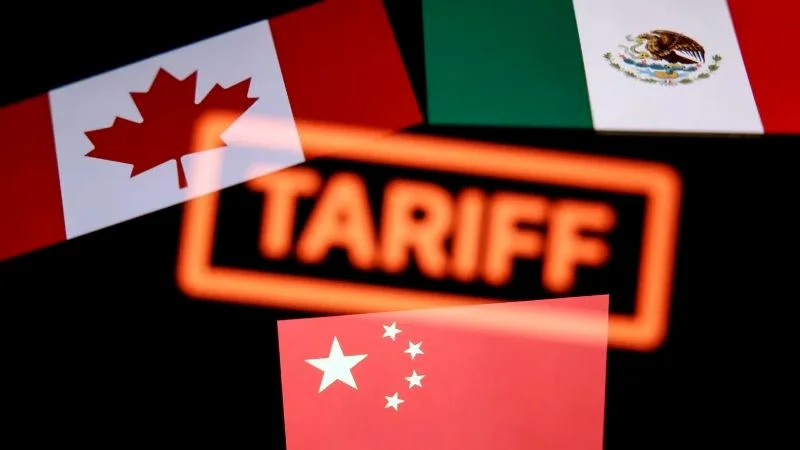
Trump has threatened to impose 25% tariffs on all Mexican and Canadian imports unless America’s two largest trading partners take more decisive action. He paused the tariffs until March 1 after some initial border security concessions from the two countries, with Mexico pledging to add 10,000 National Guard troops to its border and Canada deploying new technology and personnel and taking new anti-fentanyl steps.
Asked whether Mexico’s and Canada’s actions were good enough, Trump replied: “No, it’s not good enough,” Trump said. “it’s not good enough,” “Something has to happen; it is not sustainable, and I am altering it.”
If border security issues are not sufficiently addressed by March 1, significant tariffs on Mexican and Canadian imports could be imposed. Therefore, this most recent announcement further complicates the trade scene.