
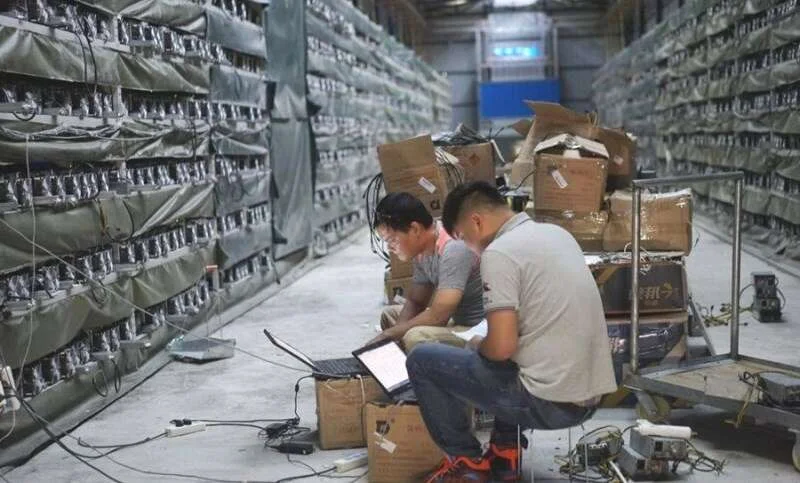
Texas could be the place for half of the world’s bitcoin miners from China
More than half of the world’s bitcoin miners are in China, but the Chinese authorities have proposed a severe crackdown on bitcoin trading and mining that could lead to what crypto circles call “the great mining migration.” This move is underway now, and it could be revolutionary for Texas.
Crypto mining is a highly energy-consuming process that produces new coins and manages a log of existing digital token transactions.
Texas has some of the lowest energy prices around the world, making it ideal for miners. With 20% of Texas’s power coming from wind, the city’s share of renewables is improving over time. The city’s deregulated power grid allows customers to choose between different power providers, and importantly, political leaders in Texas seem very welcoming and kind to Bitcoin miners in their city, full of cheap energy sources.
“You’re about to witness a dramatic change over the next few months,” said the former security engineer at Gemini crypto exchange, Brandon Arvanaghi.
“In Texas, we’ve governors like Greg Abbot encouraging mining. It will be incredible as we see a new industry in the United States,” Arvanaghi added.
Data on mining powers’ global distribution has yet to be available. Still, estimates have shown that 65% to 75% of bitcoin mining occurs in China—typically in four provinces: Inner Mongolia, Xinjiang, Yunnan, and Sichuan. The hydropower of Yunnan and Sichuan makes them renewable energy hubs, while Inner Mongolia and Xinjiang are home to many coal plants.
China’s crackdown on crypto miners began in the Inner Mongolia region before May. Beijing’s failure to accomplish climate targets caused Beijing to ask province leaders to give Bitcoin miners two months to clear out.
It is not currently clear how China will manage the next steps, but a phased rollout is possible. “It appears like we’ll have an actual implementation of the policy statement in a considerably short period of time,” said Nic Carter, founding partner of Castle Island Ventures.
Hashrate is the term used in the Bitcoin industry to define the total computing powers of all the miners in the worldwide Bitcoin network.
“Drop in the hash rate indicates that installations in China are being turned off across the country,” said Carter, who also anticipates that about 50% to 60% of Bitcoin’s total hash rate will soon no longer remain in China.
The Chinese announcement about Bitcoin miners has yet to be cemented in the policies, and it appears that miners like Alejandro De La Torre would not make an exit with losses.
De La Torre, the appointed vice president of mining pool Poolin in Hong Kong, said, “We’re tired of facing a sort of new ban coming from China every new year. “Therefore, we’re looking to expand our overall mining hash rate, and that’s the reason we are moving to countries like Canada and the United States.”
“One of the good things about Bitcoin that most pessimists underestimate is that it is a moveable market. For example, you can take it right to the source of energy,” said Upstream Data founder Steve Barbour. Upstream Data is a company that produces and supplies portable mining solutions for gas and oil facilities.
The miners’ migration wouldn’t be sudden because they would require some time to transfer their machines out of China or liquidate their assets and establish new setups elsewhere.
Top migrating destinations for Chinese Bitcoin miners
Bitcoin miners at scale are incentivized to move to regions with the cheapest power source worldwide.
According to analysts, the miners domiciled in China are looking to the U.S., Eastern Europe, Northern Europe, and Central Asia.
One likely destination for Chinese Bitcoin miners is Kazakhstan, their neighbour. Due to its coal mines, Kazakhstan has a cheap and abundant energy supply. Also, the country’s relatively lax attitude towards building can help immigrant miners construct physical setups quickly.
The owner of Xive, a company that offers hosting services and specialized equipment to miners, revealed that many Chinese miners had called him to ask about relocation choices, ranging from operations with 15 rigs to thousands.
Although Kazakhstan is a highly likely destination for Chinese miners, an exodus to the West remains to be seen.
Arvanaghi sees North America picking up pace with the hash rate over the next few months. He says Texas is the best place to start a mining business as the city has some very low-priced electricity not just in the U.S. but worldwide. He said an estimated $30 million to $40 million is enough to make you a premier miner in Texas, United States.
Wyoming is the second-best choice for world Bitcoin miners. The city has pro-bitcoin policies and could be another mining destination, as Arvanaghi predicted.
Whether in Texas or Wyoming, a few limitations exist to the United States becoming a mining destination for global Bitcoin miners. One problem is the likely delay in completing the physical infrastructure needed to host miners.
Completing the infrastructure for the immigrant miners may take up to nine months, and the U.S. may not be extra quick in terms of onshoring stray miners.
Another area that can limit the United States’ chances is the need for shipping containers, thanks to the blows of the COVID-19 pandemic.
The reliability of the Texas power grid is probably the most important question yet to be answered regarding Chinese Bitcoin miners’ migration to the United States. A storm in early 2021 ruined large swaths of the state and reinitiated a discussion over whether it should go for a winter-proof of its systems. This project could potentially affect fees and taxes for those hoping to tap into Texas’ power grid.
What will be next for Bitcoin mining?
For now, there is not much mining capacity worldwide that can manage the Chinese miner displacement. While the miner’s hassle to get a new home, we might see the hash rate stay offline. That would mean all the remaining miners stay profitable for a while.