
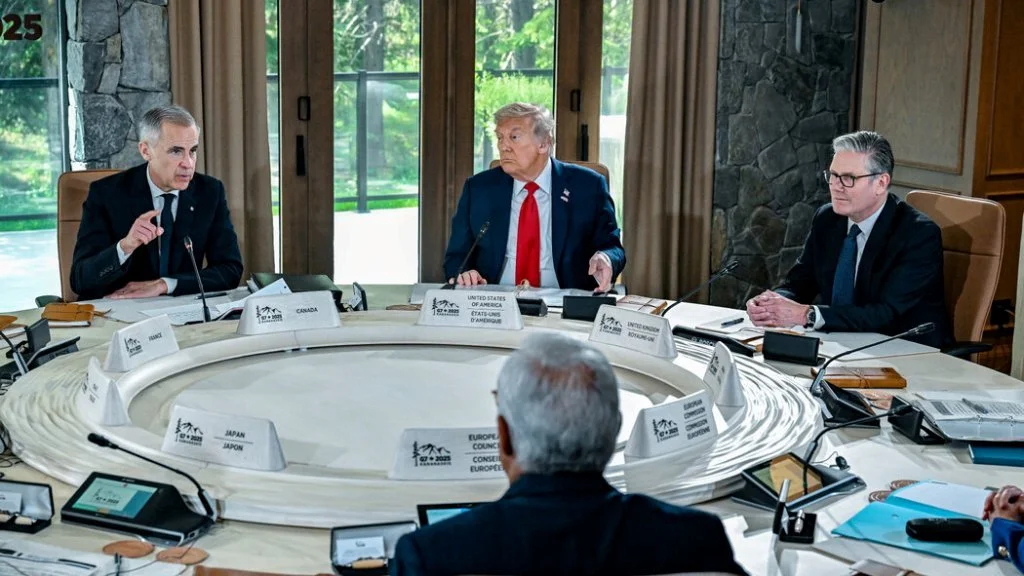
Trump Signals Israel-Iran Conflict Escalation, Leaves G7 Summit Early

Get an AI-generated summary of this article.

AI-generated article summary

Key Points:

  • U.S. President Donald Trump left the G7 summit in Canada early on June 17, 2025, citing the intensifying Israel-Iran conflict.
  • Trump warned Iranians to “immediately evacuate Tehran” and denied pursuing a ceasefire, focusing on “bigger” goals.
  • G7 leaders supported Israel’s right to self-defense and condemned Iran as a source of “regional instability and terror.”
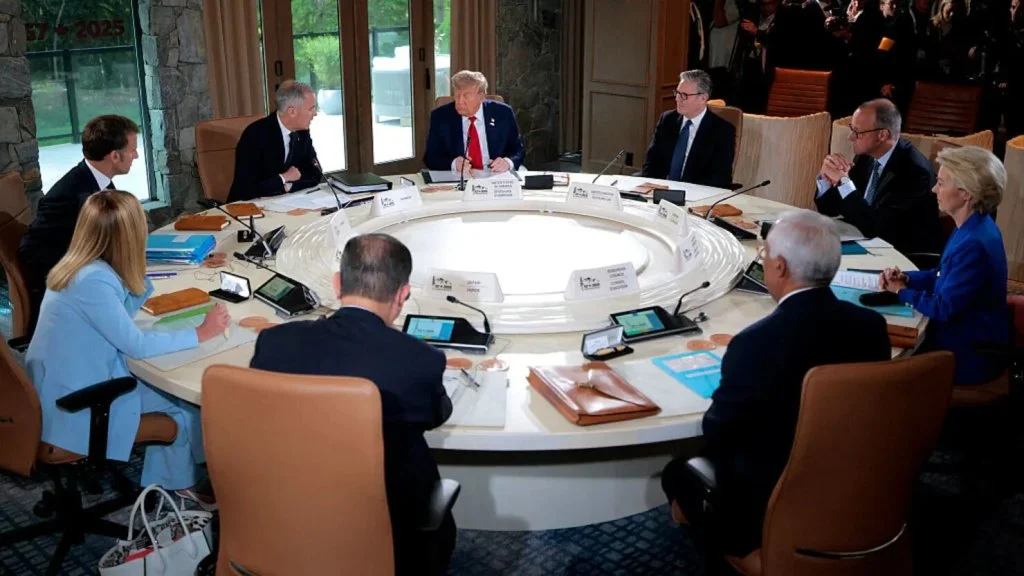
G7 leaders warned Iran and supported Israel's right to self-defense.

President Donald Trump left the G7 summit in Canada early on Tuesday, June 17, 2025, to focus on the worsening Israel-Iran conflict. He said his departure was for “much bigger” reasons than a ceasefire between Tel Aviv and Tehran. On Truth Social, Trump denied French President Emmanuel Macron’s claim of a ceasefire offer, saying, “He has no idea why I’m heading to Washington.”

Trump warned Iranians to “immediately evacuate Tehran,” hinting at more Israeli strikes. White House Press Secretary Karoline Leavitt cited the Middle East crisis as the reason.

G7 leaders backed Israel’s right to defend itself and called Iran the “principal source of regional instability and terror.”

They urged de-escalation and a Gaza ceasefire, stressing Iran must never have a nuclear weapon. Trump signed the statement after changes, despite earlier hesitation.

The G7 includes the U.S., U.K., Canada, France, Germany, Italy, and Japan, with guests from the European Union, India, and others. China criticized Israel’s attacks and offered to mediate.

The Israel-Iran conflict, now in its fifth day, intensified with Israel’s claim of killing Iran’s top commander, Ali Shadmani. Iran’s missile strikes killed eight in Israel. Trump’s Tehran evacuation call echoed Israel’s warning of strikes on “military infrastructure.” On X, @IsraelWarRoom quoted Trump pushing for Iran to abandon its nuclear program entirely.

At the summit, Trump signed a trade deal with U.K. Prime Minister Keir Starmer, easing tariffs but not on steel. He failed to reach a deal with Japan’s Shigeru Ishiba. Trump called Russia’s 2014 G8 expulsion a “mistake,” suggesting it could have prevented Ukraine’s 2022 invasion. He skipped meetings with Ukraine’s Volodymyr Zelensky and Mexico’s Claudia Sheinbaum.

The summit, meant to address trade and Ukraine, was dominated by the Middle East. European leaders, like Ursula von der Leyen, urged diplomacy. Trump’s nuclear deal push with Iran stalled after canceled talks. His evacuation warning raised fears of U.S. involvement, though officials denied it. On X, @japantimes highlighted the G7’s pro-Israel stance.

About Writer

More News

Two Months of Iran War | Who Is Winning, Who Is Losing, and Who Is Still Deciding?

Two Months Into the Iran War When Donald Trump launched the war on Iran on February 28, he told the world it would be quick, decisive, and worth it. Ten days in, he said the United States had already won the war “in many ways.” (function(w,q){w=w||;w.push()})(window,"_mgq"); Two months later, a definitive end to the conflict is nowhere in sight. A ceasefire is in place but fragile. Diplomacy keeps stalling. And almost every country pulled into this war willingly or not is paying a price it did not budget for. (function(v,d,o,ai){ai=d.createElement('script');ai.defer=true;ai.async=true;ai.src=v.location.protocol+o;d.head.appendChild(ai);})(window, document, '//a.vdo.ai/core/v-livenewsof/vdo.ai.js'); “There aren’t any real winners from the war, but there are some...

Trump Criticizes Pope Leo Over Iran Peace Appeal

(function(w,q){w=w||;w.push()})(window,"_mgq"); US President Donald Trump has sparked fresh controversy after publicly criticizing Pope Leo following the pontiff’s appeal for peace amid the ongoing Iran conflict. The clash highlights growing tension between political leadership in Washington and the Vatican’s moral stance on war and global diplomacy. The dispute began after Pope Leo made a strong statement urging world leaders to avoid further escalation and prioritize peace. Without directly naming Trump, the pope warned against using power or religion to justify war. His remarks were widely interpreted as criticism of US policy. Trump responded on social media, calling the pope weak on crime and...

Why Trump Is Blockading a Strait Iran Is Already Blocking

After peace talks in Islamabad collapsed, President Trump announced the US Navy would “immediately” begin blockading the Strait of Hormuz. There is one obvious question: why would the US blockade a waterway it has been demanding Iran reopen? (function(w,q){w=w||;w.push()})(window,"_mgq"); The Strait Is Not Fully Closed Iran has not technically sealed the Strait completely. It has been allowing some vessels through in exchange for tolls of up to $2 million per ship. Crucially, Iran has kept its own oil flowing throughout the war, exporting an average of 1.85 million barrels per day through March, slightly above pre-war levels, according to data firm Kpler. The...

Islamabad Talks | US and Iran Fail to Reach a Deal After 21 Hours

The most significant US-Iran diplomatic meeting since the 1979 Islamic Revolution ended without a deal on Sunday. After 21 hours of face-to-face talks in Islamabad. Both sides left the table blaming each other. The ceasefire that expires April 22 now hangs by a thread. (function(w,q){w=w||;w.push()})(window,"_mgq"); What Happened in the Room The talks were the first direct US-Iranian engagement since the 2015 top-level engagement. Vice President JD Vance led the American delegation alongside Steve Witkoff and Jared Kushner. Iran was represented by Parliament Speaker Mohammad Bagher Ghalibaf and Foreign Minister Abbas Araghchi. Al Jazeera's correspondent in Islamabad described the outcome as “neither a breakthrough...

US Iran Talks Could Reshape Middle East Power Balance

A Rare Diplomatic Moment Between US and Iran The United States and Iran have entered a critical phase of diplomacy as both countries begin direct negotiations in Islamabad, Pakistan. These US Iran talks come after weeks of rising tensions that brought both nations close to conflict. While a temporary ceasefire is currently in place, the situation remains fragile. (function(w,q){w=w||;w.push()})(window,"_mgq"); This meeting is significant because it represents one of the few direct engagements between Washington and Tehran in recent history. For decades, relations between the US and Iran have been shaped by mistrust and political conflict. The decision to begin talks shows that...

Latest Articles