
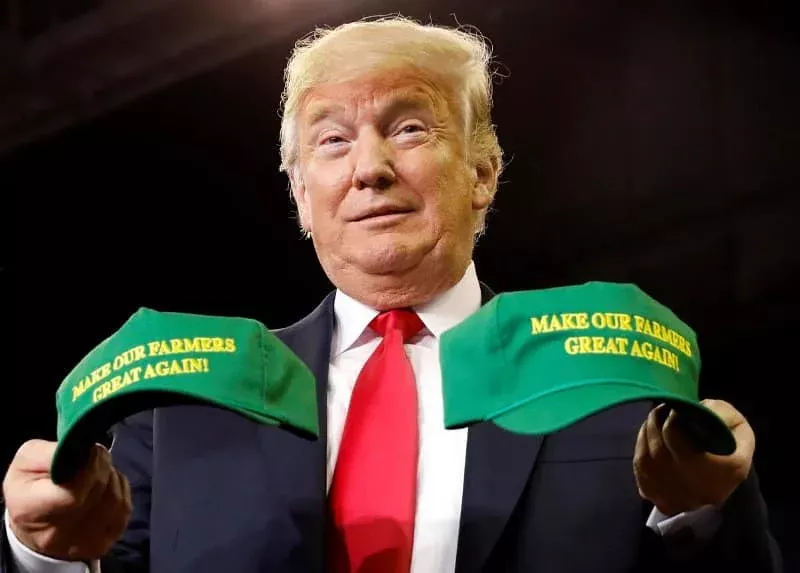
American farmers are struggling in 2025, battered by high costs, foreign retaliation from tariffs, labor shortages, driven by immigration, and falling commodity prices. Farm production expenses are projected to reach $467.4 billion, a $12 billion increase from the 2024 estimate. Farm bankruptcies surged in the first half of the year to the highest since 2021, per U.S. courts data.
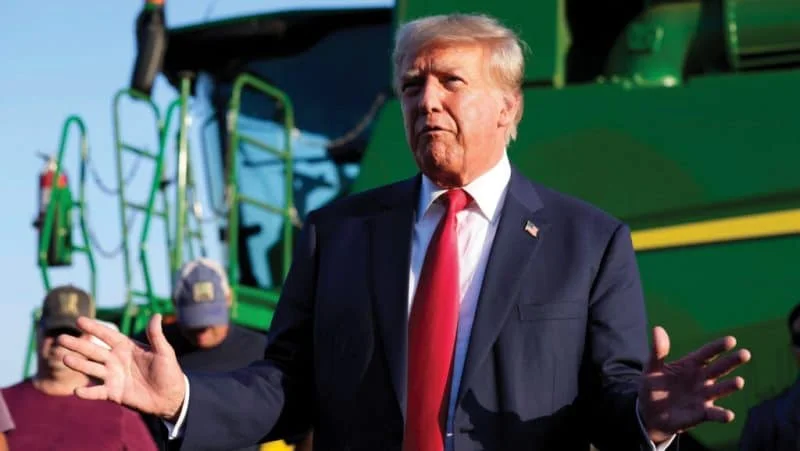
President Trump’s policies, such as the deportations of migrant workers and the revival of trade tensions with China, have only exacerbated the situation, particularly in the case of row crops, including soybeans, corn, wheat, sorghum, and cotton. During a briefing on October 1, 2025, Agriculture Secretary Brooke Rollins said, “We can’t deny that the farm economy is going through a big struggle right now. Particularly our row croppers.”
With a value exceeding $24 billion, soybeans are the United States’ most significant agricultural export in 2024. The situation is clearly depicted in the example. Half of the exports went to China last year, whereas since May 2025, there have been no sales of U.S. soybeans to China at all. The reason is a 20% retaliatory tariff from Beijing in response to Trump’s tariffs that have made U.S. crops less competitive.
China has turned to South America for the supply of soybeans, purchasing at least 10 shipments of Argentine soybeans after Argentina eliminated export taxes, supported by a U.S. $20 billion bailout to Argentina’s central bank.
Brazil sealed a deal with China in July, thereby increasing its dependence on China and further weakening American farmers. American Soybean Association President Caleb Ragland stated on September 24, 2025, “US soybean farmers have been clear for months: the administration needs to secure a trade deal with China.”
After interagency meetings with the Departments of Agriculture and Treasury, the White House is completing a multi-billion-dollar relief package. Trump blamed China for not taking soybeans “for the sake of negotiations,” and said he would discuss that with President Xi Jinping in South Korea next month.
Two significant considerations under discussion are reallocating some of the tariff income to farmers or utilizing the USDA’s Emergency Commodity Assistance Program (ECAP) on an off-the-top basis. Originally started in March 2025 to offer immediate payouts for the 2024 crop year, the account provides direct payments.
The fund could be used with an assistance level ranging from $10 to $14 billion. A combination is likely, with aid ranging from $10 billion to $14 billion. One official stated that, “The final figure will depend on how much farmers need and the amount of tariff revenue coming in.” Trump posted on social media, “We’ve made so much money on Tariffs that we are going to take a small portion of that money and help our Farmers.
I WILL NEVER LET OUR FARMERS DOWN!”
In a confidential meeting, Trump asked his staff to support the agriculture sector, as he believed farmers would be the ones voting for him in the next presidential election. Administration members view farming as a crucial security issue, and as they say, “We have to grow our own food. We absolutely cannot rely on imports.” Rollins, who is always in touch with the White House, described the use of tariff money for diversion as “an elegant solution.”
A secret text found on the phone of Treasury Secretary Scott Bessent revealed Rollins’ reaction to Argentina selling soybeans to China following a U.S. bailout, thereby exposing the administration’s worries. An Indiana farmer said, “We’re hopeful negotiations are moving forward, but with harvest here, patience may be running thin.”
Beyond tariffs, farmers face inflation in equipment, fertilizer, and seeds, per the American Farm Bureau Federation. Deportations have worsened labor shortages, with migrant workers key to harvesting. Poor credit conditions threaten more bankruptcies, per the bureau. For “negotiating purposes,” Trump, of course, blamed China for the refusal of the soybeans and declared that he intends to discuss the matter with President Xi Jinping during his visit to South Korea next month.
A bailout provides, on the one hand, a limited amount of time for relief, but on the other hand, a farmer such as Ragland would insist on a trade deal with China to reopen the markets. Some reports suggest that the government’s support for Argentina had an unexpected result, benefiting its competitors.
SoybeanAssoc on X published a post on October 1, 2025, endorsing the terms of the negotiations. However, experts suggest that the bailout proceed and it will almost certainly utilize the funds obtained from ECAP or tariffs. Further, it may ignore concerns and other ongoing disputes. However, farmers would prefer dependable markets over relying on subsidies.